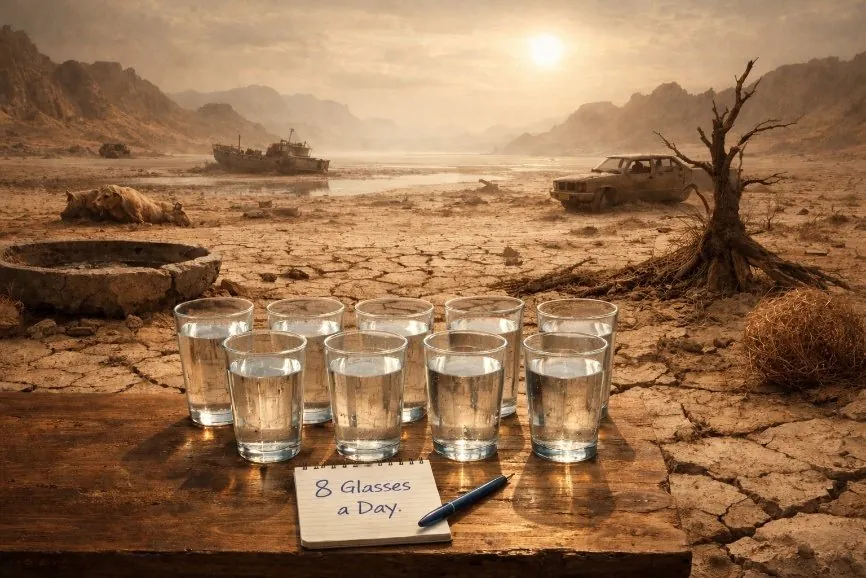
Ask ten people how much water a person should drink each day and at least eight will answer without hesitation: “Eight glasses.” Or perhaps “two litres.” They'll say it the way we recite times tables, with absolute confidence and almost no idea where the number came from.
That's worth pausing on, because the eight-glasses rule is one of the most widely accepted health rules on the planet. It is also one of the least examined.
The birth of a bad idea
The rule didn't emerge from a large clinical trial or decades of hydration research. It appears to trace back to a misinterpreted 1945 recommendation from the US Food and Nutrition Board, which suggested adults need roughly 2.5 litres of water a day, including the water in their food.
Somewhere along the way the details eroded. The food part was forgotten. The fact that people are different was ignored. And a flexible guideline hardened into a rigid rule.
Eight glasses became law.
Why simple rules feel so safe
Simple rules are comforting. They're easy to remember, they sound scientific, they seem to apply to everyone, and they spare us from having to think. Unfortunately, biology doesn't care about what feels convenient.
Imagine fuelling every car with exactly the same amount of petrol, regardless of engine size, terrain or distance, and expecting identical performance. Absurd. Yet that's precisely what we do with water.
A tale of two bodies
Picture two people. One is 5ft 2in, works at a desk in a cool office, carries little muscle and rarely sweats. The other is 6ft 3in, physically active, lives somewhere warm, carries a lot of muscle and talks all day for a living.
Both drink eight glasses of water. Only one of them stands a chance.
How much water you need depends on your weight, muscle mass, metabolic rate, activity, climate, stress, illness, even how fast you breathe. The book estimates that speaking alone can use up to 30 ml an hour. The average adult loses two to three litres a day at rest.
The question we should be asking
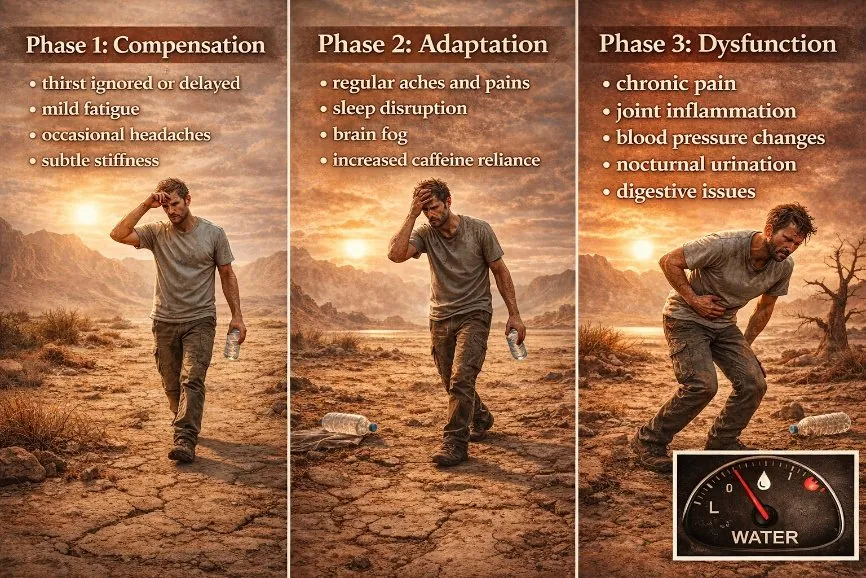
The real hydration question isn't “How much water should I drink?” It's “How much water am I using?” Your body is a living balance sheet: water in, water out. When more goes out than comes in, even by a little, the deficit compounds over days, weeks and months.
There is no universal number. There is only adequacy relative to demand.
That shift, from a fixed target to a relationship between intake and usage, sits at the heart of The Irrefutable Power of Water. To reflect on your own routine, try the free Water Drinking Habits Assessment.
This article is for education and general wellbeing. It isn't medical advice. Persistent or unexplained symptoms deserve proper medical assessment, and if your doctor has advised you to limit fluids, follow their advice.

The full story of how a flexible guideline hardened into a rigid rule is in Chapter 2, The Myth of ‘Enough’.
Enjoyed this article? Get The Water Letter.
New articles, author insights, book updates and events.
Sources: the ideas in this article come from The Irrefutable Power of Water. See the book's scientific references.