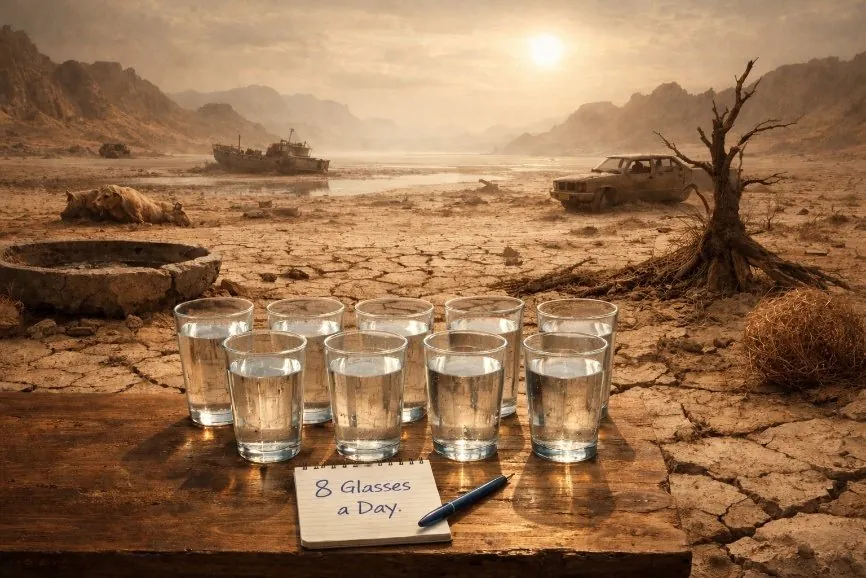

If muscles were able to speak, they wouldn't ask for protein. They would ask for water. Lots of it.
We tend to think of muscle as solid tissue that we build in the gym. In reality, muscle is around 75–80% water, and it holds three to four times more water than fat. That water isn't there for show. It carries nutrients, controls temperature, removes waste and, crucially, carries the electrical signals that tell a muscle when to contract and when to let go.
Cramp is an electrical emergency
Every contraction and relaxation depends on sodium, potassium, calcium and magnesium, and all of those minerals travel through water. When fluid runs low, electrolyte balance becomes unstable, signals misfire and muscles fail to relax fully.
Cramp isn't random. It's an electrical emergency.
The football match that explains it all
Watch any football match that goes to extra time. The cramps rarely come early. They arrive after the first ninety minutes, when glycogen stores are empty, fluid losses are significant and electrolyte balance is disrupted. Players who are elite, monitored and professionally conditioned go down clutching their calves.
It's so predictable that, as the book describes, the game's rule-makers introduced hydration breaks and extra substitutions to reduce the risk.
It was physiology playing out on grass.
What it means for the rest of us
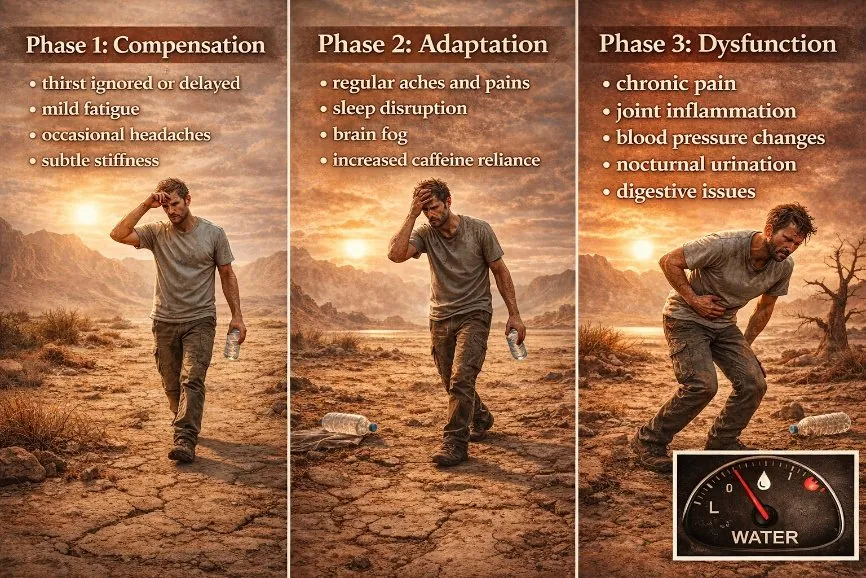
If well-conditioned athletes cramp when fluid and electrolytes run low, what's happening in office workers, carers, manual workers, older people and anyone under chronic stress? The author suggests that for many people the same mechanism may show up more quietly, as chronic stiffness, backache, a stiff neck, jaw tension, “mystery” aches, and calf cramps that wake us at night.
As the book puts it: same mechanism, different stage.
Why night cramps are so common
Hydration is often at its lowest at night, after a full day of losing fluid without properly replacing it. The author suggests that when muscles finally get the chance to relax, they may not fully loosen, and the result can be a sudden, painful contraction.
Stretching helps, briefly
Stretching moves fluid around and forces a reset, so it does bring relief. But without restoring hydration, the problem comes back.
Stretching treats the symptom. Water corrects the cause.
Muscles need three things to work properly: energy, electrolytes and water. Take away any one and function breaks down, which is why cramp is so often the final straw, not the first issue.
Frequent, severe or one-sided cramps, or cramps with swelling, weakness or numbness, should always be checked by a doctor, as they can have other causes.
This article is for education and general wellbeing. It isn't medical advice. Persistent or unexplained symptoms deserve proper medical assessment, and if your doctor has advised you to limit fluids, follow their advice.

Chapter 8, Muscle, Cramp & Electrical Chaos, explains the muscle–water–energy triangle in full.
Enjoyed this article? Get The Water Letter.
New articles, author insights, book updates and events.
Sources: the ideas in this article come from The Irrefutable Power of Water. See the book's scientific references.