Chapter 2
The Myth of ‘Enough’: How We Learned to Drink Too Little
If you were to ask ten people how much water a person should drink each day, it’s very likely at least eight of them would confidently say,
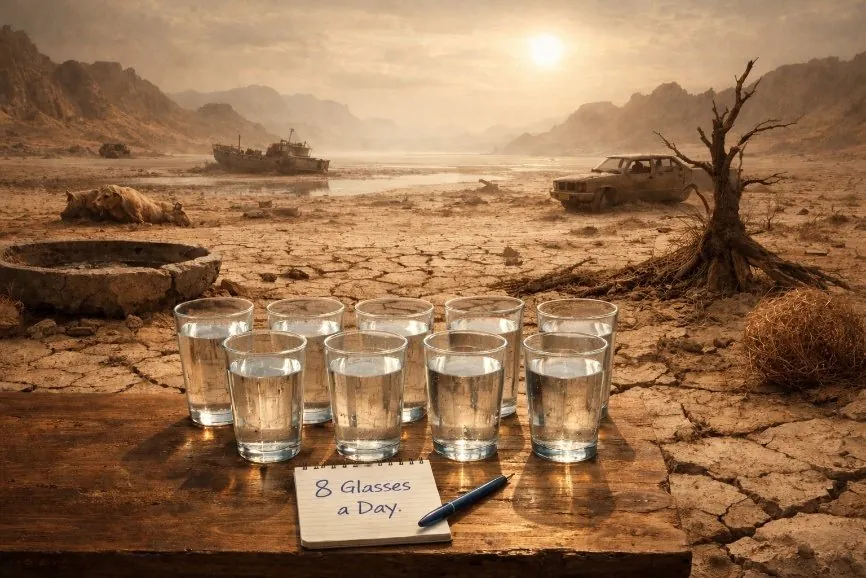
‘Eight glasses.’ Or ‘2 litres’
They’ll say it the way people recite their times tables or a number sequence they memorised as a child, without hesitation or curiosity and with absolutely zero thought as to where the idea came from.
This concept of eight glasses of water a day has become one of the most widely accepted rules of health on our dear planet.
It’s also one of the least thought about.
This chapter is not about encouraging excessive water intake or overriding medical advice. It is about understanding why a one-size-fits-all rule has quietly failed so many people.
The Birth of a Bad Idea
The ‘eight glasses a day’ recommendation didn’t emerge from a large-scale clinical trial. It wasn’t the result of decades of hydrational research. And it certainly didn’t come from observing any physiological individualised data.
It appears to have originated from a misinterpreted 1945 recommendation by the U.S. Food and Nutrition Board, which suggested that adults require approximately 2.5 litres of water per day, including water from food.
Somewhere along the way, the details became eroded.
The food component was forgotten. The fact that people are different was ignored. And a flexible guideline hardened into a rigid rule.
Eight glasses became law.
Why People Love Simple Rules (Even When They Don’t Make Sense)
Simple rules feel safe.
They free us from needing to think, calculate variables, make adjustments, or pay attention. They provide certainty in a world that feels increasingly complex.
‘Eight glasses’ is comforting because:
- it’s easy to remember
- it sounds scientific
- it applies to ‘everyone’
- it removes responsibility
Unfortunately, biology doesn’t care about what feels convenient.
Your body is not a standard-issue appliance. It is a dynamic system that adapts and responds according to demand.
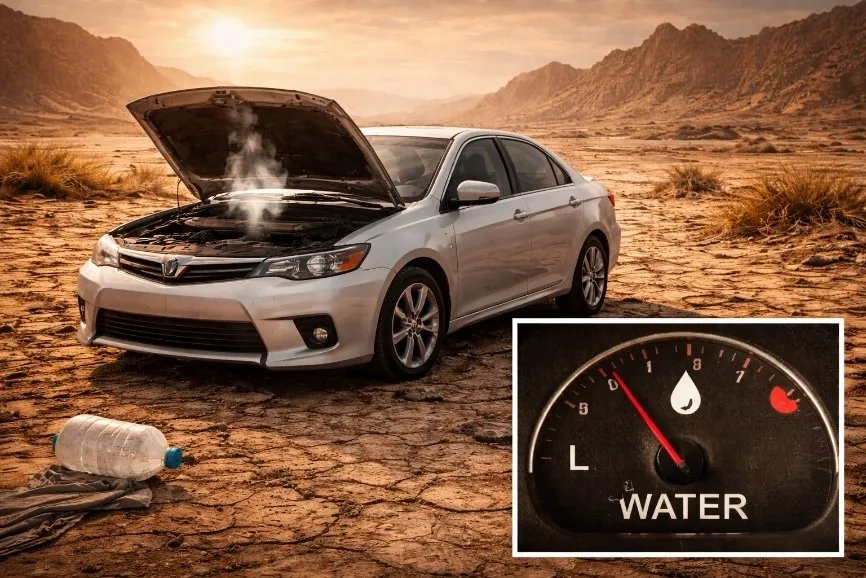
Imagine fuelling every car, regardless of its size, engine capacity, terrain, or distance, with the same amount of fuel and expecting an identical performance.
Absurd, right?
Yet this is exactly what we do with water.
A Tale of Two Bodies
Let’s imagine two people.
Person A:
- 5ft’2’
- sedentary job
- cool climate
- low muscle mass
- minimal sweating
Person B:
- 6ft’3’
- physically active
- warm climate
- high muscle mass
- frequent sweating
- speaks all day for work
Both drink eight glasses of water.
Only one of them stands a chance.
How much water a person needs depends on:
- how much they weigh
- how much muscle mass they have
- their metabolic rate
- how much exercise /physical activity they do
- how hot/cool it is
- stress hormones
- if they are ill
- how fast they breathe
Yet we pretend that eight glasses can cover them all.
It can’t. And for many people, it doesn’t even come close.
Thirst Is a Terrible Teacher
One of the most dangerous hydration myths is the idea that thirst is a reliable signal.
It isn’t.
By the time you begin to feel thirsty, your body is often already deeply dehydrated.
Studies in Physiology & Behaviour identified that thirst typically appears after 1–2% body water loss, the exact range where cognitive performance, mood, and physical function already begin to show signs of decline.
Thirst is not an early warning system. It’s a late-stage alarm.
Relying on thirst alone is like waiting for your car to grind to a halt before checking the fuel gauge.
— The chapter continues in the book —