Water retention is one of the most upsetting symptoms there is, because you can see it. You can ignore fatigue and put up with pain, but swelling demands attention. Shoes feel tight by midday. Ankles have disappeared by evening. Rings barely fit.
We're taught to blame too much water, too much salt, hormones or circulation. In more serious cases swelling can be linked to heart, kidney or lymphatic conditions, and then medical care is always needed. In the book, Erran offers a different perspective on many everyday situations: that the body may sometimes hold on to water because it isn't getting enough. Sudden, severe or one-sided swelling, or swelling with breathlessness or chest pain, needs urgent medical advice.
A lesson from the desert
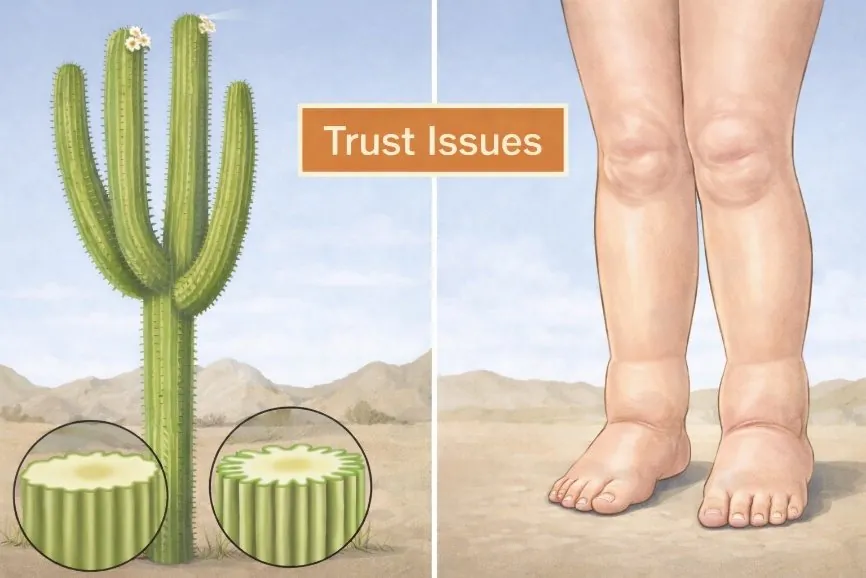
A cactus doesn't swell up because it has too much water.
It swells because water is scarce, the supply is unpredictable and survival depends on storage. So it develops thick stems to hold water, minimises loss and grows deep roots to search for more.
Now think of the cactus as the human body.
A water trust issue
When daily intake is low, sporadic or inconsistent, the body doesn't panic. It plans. It shifts into conservation mode: prioritising the organs nearest the heart and brain, and holding fluid in the tissues furthest from the centre, where gravity pulls hardest. That's why swelling shows up in the ankles, feet, lower legs and hands.
This isn't something going wrong. It's intelligent adaptation.
Retention isn't the problem. Retention is the signal.
Reassurance, not removal
In the author's view, if the body is storing water because it doesn't trust the supply, the answer isn't simply to remove water. It's to reassure the system with steady, consistent intake, day after day, until it no longer feels the need to hoard.
That is a very different conversation from the one most people have about swelling. And it's one of the reasons readers say the book makes them see their own bodies differently.
This article is for education and general wellbeing. It isn't medical advice. Persistent or unexplained symptoms deserve proper medical assessment, and if your doctor has advised you to limit fluids, follow their advice.
Chapter 10, Water Retention, explores the cactus principle, the water trust issue and how the body finally ‘exhales’.
Enjoyed this article? Get The Water Letter.
New articles, author insights, book updates and events.
Sources: the ideas in this article come from The Irrefutable Power of Water. See the book's scientific references.